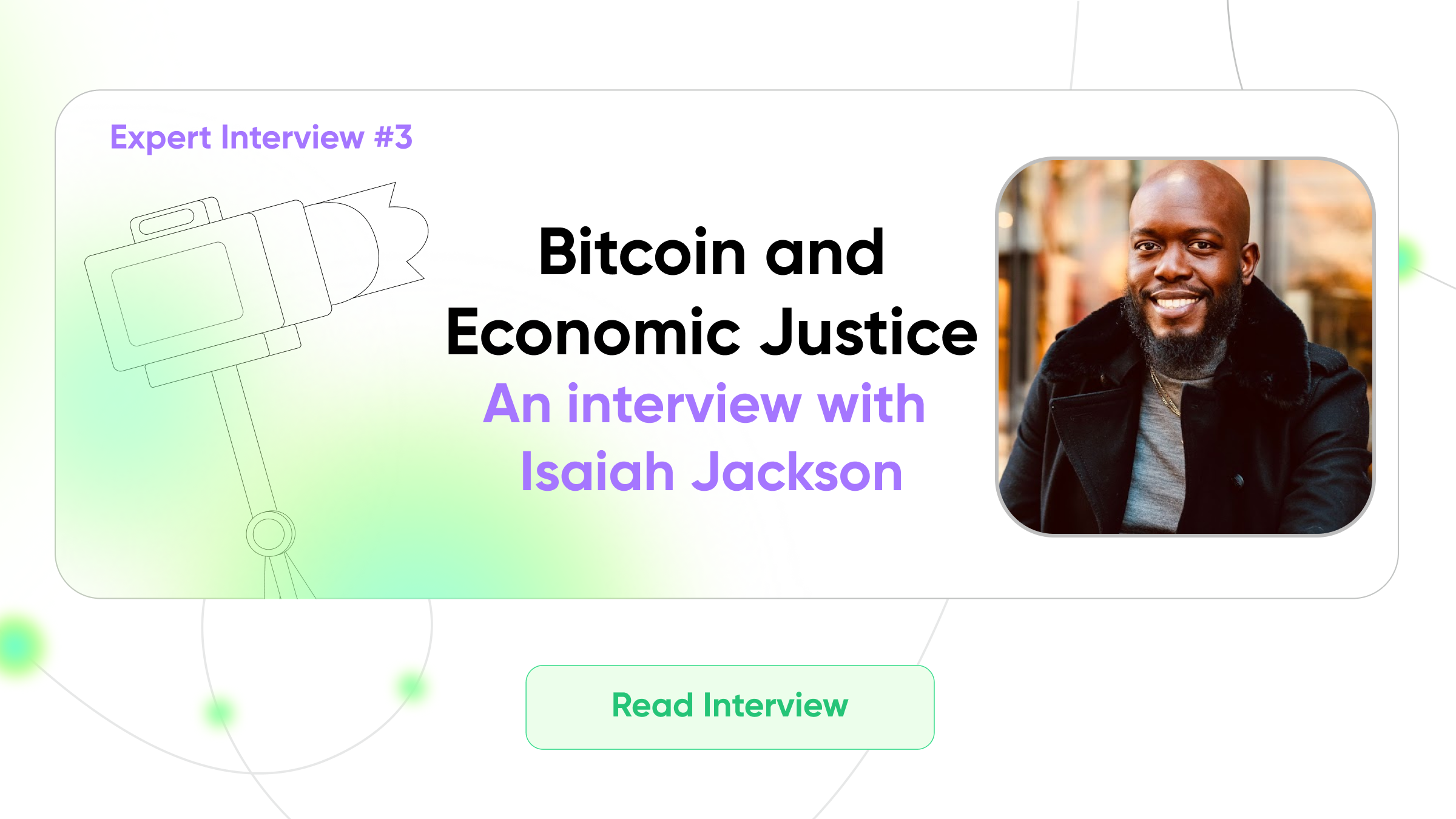
Mintlayer Expert Interview Series #3
Bitcoin has experienced a sharp correction in recent weeks, pulling back significantly from its recent all time highs. For many, the instinct is to panic or question whether Bitcoin's promise was ever real. While the pullback has been severe, it remains within the range of corrections Bitcoin has seen during previous bull markets.
Yet this moment reveals something more important than short-term price action: it shows us who truly understands what Bitcoin is and why it matters. It is still decentralized, anti-inflationary, and permissionless. No bank, government, or corporation can alter its supply or censor transactions. For communities systematically excluded from traditional wealth-building tools, these properties matter more than ever.
This is why we're honored to feature Isaiah Jackson for our third Expert Interview. Isaiah is a best-selling author, educator, and award-winning speaker with over 12 years in the Bitcoin industry. Known as Bitcoin Zay, he created the first Bitcoin Summer Camp and co-founded Black Bitcoin Billionaires, the largest minority Bitcoin group in the world. Additionally he serves as lead teacher for The Bitcoin Learning Academy in Miami. Featured in Forbes, Time Magazine, CNBC, Fox Business, and Coindesk, Isaiah addresses a critical question: can Bitcoin actually close the wealth gap for communities that traditional finance has failed?
Bitcoin and Closing the Wealth Gap
For people who have never heard of Bitcoin and Black America, how would you explain the core idea in one or two sentences?
The core idea is that Bitcoin is for everybody, including the black community. This book was written as a signal to other black Americans that we are invited to the Bitcoin party as well and we should take advantage of this new innovation.
What was the moment when Bitcoin went from "interesting tech" to "this could change the path for my community"?
One of the first people I saw speak about Bitcoin was Max Keiser in 2013. He had various clips and tweets pointing out the opportunity for the black community to use Bitcoin as a freedom tool. That lit the spark and I went down a rabbit hole researching economic disparities and private property rights throughout American history. Once I saw that Bitcoin's properties solved a lot of our past transgressions I decided that in 2019 now is the perfect time to present this idea.
Historically, African American communities had to build their own financial and social institutions when they were excluded from existing ones. Do you see Bitcoin as part of that same tradition?
Yes. I see Bitcoin as the ultimate tool for black communities to build a financial foundation. In the past, we have seen black communities like the various "Black Wall Streets" that were built, maintained and even praised. However Black Wall Street was burned to the ground and you can't burn down Bitcoin.
Now that institutions and banks have stepped into the Bitcoin realm, is it still an asset that could close the wealth gap for underserved communities, or is it another tool for the wealthy and empowered to grow richer?
Bitcoin is absolutely still a tool that can close the wealth gap for underserved communities. Everyone looks at the news and the price of Bitcoin which can make it seem as though institutions and banking have taken over. However, each individual can protect their wealth by stacking sats, running a node and transacting over the Lightning network. Inflation and taxes are inevitable with fiat currency and Bitcoin allows anyone in an underserved community to grow wealth undeterred. We are still very early in this space.
In the book you talk about economic empowerment, ownership, and parallel systems. How do you see Bitcoin connecting to real world assets like property, businesses, and infrastructure in Black communities?
Today you can use your Bitcoin as collateral to buy property and necessary goods. Businesses can accept Bitcoin for payment and hold long term in their treasury. Churches can accept Bitcoin for tithes. Investors can get exposure to Bitcoin through ETFs or stocks like Strategy. Over the past 17 years a lot of the hard work has been done to create a bridge from the old financial system to Bitcoin and all the black community has to do is participate.
How do you talk to older generations who lived through scams, redlining, or predatory lending and naturally distrust new financial tools?
The first thing I point out is that the redlining and predatory lending only happened because you need "permission" in the fiat system. Bitcoin is permissionless and censor resistant so nobody can stop you from using Bitcoin or any decentralized tools as you see fit. Most people in the older community lived in a world where the financial system "worked" but I would argue that fiat currencies are destined to fail and Bitcoin is the life boat they are looking for. A lot of my older students have a fixed income, so they can clearly see how inflation has slowly lowered their purchasing power over time. By comparison Bitcoin increases your purchasing power over time.
Policy, Sovereignty, and the Future of Bitcoin in Marginalized Communities
When you look at the current direction of regulation in the United States, do you feel more optimistic or more concerned about Bitcoin's role in marginalized communities?
Now that the US has a Strategic Bitcoin Reserve and has been favorable I feel optimistic about regulation going forward. However, my cypherpunk roots will not allow me to completely trust any government. Bitcoin is permissionless so even with regulations and operations like Operation Chokepoint 2.0 in effect nothing can stop a global currency like Bitcoin. I think everyone is realizing, including politicians, that you can't regulate innovation and they have accepted that Bitcoin is a crucial tool for our financial future.
Some people say "we will fix the system from inside"; others say "opt out and build parallel rails." Where do you personally land on that spectrum?
My thoughts are that Bitcoin was not invented in a vacuum so the financial world that existed still needs people who can fix the system from the inside. However, I think we should slowly transition to opting out completely and build parallel rails for Bitcoin. This could take another decade or two but it is worth the wait. Once people can onboard, transact, save and invest without ever touching a bank account again I think we will see Satoshi's vision fulfilled. Bitcoin is the trojan horse that the government has let inside and our soldiers are working hard in their respective positions to bridge the gap to a Bitcoin future.
Do you think African American communities should prioritize learning about self custody and non custodial tools before anything else, given that history?
Yes. As I like to say, "No Keys, No Cheese". Self-custody is the most important aspect of Bitcoin because if you don't own your keys you don't own Bitcoin. People may be intimidated and scared to lose their wealth but that is why Bitcoin education is the next important aspect in this industry. The confidence to run a node and verify transactions, self-custody Bitcoin and handle your UTXOs comes with more education and it has been my life's work to provide that to anyone who wants to learn.
Closing Thoughts
Isaiah's perspective arrives at a critical moment. As Bitcoin trades well below recent highs and fear dominates headlines, it's easy to lose sight of fundamentals. The recent correction doesn't change Bitcoin's core properties: decentralized, permissionless, anti-inflationary. No institution can alter its supply. No government can censor transactions. No bank can freeze your wallet if you hold your own keys.
Isaiah's message is clear: we are still early. Self-custody, education, and long-term thinking remain the foundation. Bitcoin isn't get-rich-quick. It's a tool for preserving purchasing power, building parallel financial systems, and opting out of a system that has repeatedly failed marginalized communities.
As Isaiah reminds us, "No Keys, No Cheese." The fundamentals haven't changed. Bitcoin's supply remains capped at 21 million. Fiat inflation continues. And the ability to hold, transact, and build wealth outside centralized permission remains as powerful today as when Satoshi released the Genesis Block.
Bitcoin isn't going anywhere. The question isn't whether it will recover. The question is whether you'll use this moment to educate yourself, stack sats, and position for the next phase. As Isaiah makes clear, every underserved community is invited to this party. The infrastructure exists. All that's left is to participate.
Thanks for joining us for our second Expert Interview. Stay tuned for more conversations with the leaders shaping the future of finance.
About the Guest: Isaiah Jackson
Isaiah Jackson is a best-selling author, educator and award-winning speaker with over 12+ years of experience in the Bitcoin industry. Also known as Bitcoin Zay, he is the creator of the first Bitcoin Summer Camp and co-founder of Black Bitcoin Billionaires, the largest minority Bitcoin group in the world.
Currently he is building the Bitcoin Lifestyle brand "What Would Satoshi Do" and serves as lead teacher for The Bitcoin Learning Academy in Miami, FL.
Jackson has been featured in Forbes, Time Magazine, CNBC, Fox Business and Coindesk.
Where to find Isaiah:
- Twitter/X: @bitcoinzay
- Website: whatwouldsatoshido.com
Discover more
.png)
Stablecoins, Payments, and Asia as the Testbed
Rachel Ong discusses stablecoins as infrastructure, Asia's adoption wave, and bottlenecks to broader business use.

Building Better B2B Investments: The Craft of Early Stage Investing
How early stage B2B investing should be craft, not gambling, with insights on transparency and enterprise decision-making.
.png)
Is Regulation Blockchain’s Next Real Breakthrough?
A conversation with legal expert Ícaro Avelar on how regulatory clarity is unlocking new opportunities for compliant blockchain innovation.